Wayne Theibaud
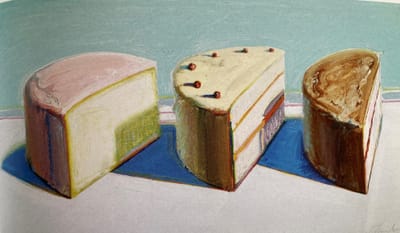
He was born in 1920 in Arizona and grew up in a Mormon family in California, living a long time until he died at 101 on December 25, 2021. He was known for his paintings of American everyday items such as food, shoes, cakes, as well as the streets of San Francisco. Thiebaud worked from life, his most popular work included colourful cakes, slices of pie and candy such as lollipops in which he captured a unique American sensibility. He uses heavy pigment and strong colours in his paintings, along with defined shadows.
Thiebaud belongs more to a classical tradition of painting than to the pop art world. His cake pictures with their use of repetition might seem similar to Warhol’s soup cans but his work is more warm, amusing and even nostalgic. As a painter, he experimented with brushstrokes, colour, light and shadow. The cakes reflect the work of 18th century still life paintings.
By the 1950s, he started using thicker gestural brushstrokes, painting pinball machines, boys on the beach, bakery counters and cosmetics using bright colours. Later on, he turned to landscapes, playing around with unusual viewpoints and horizon lines of San Francisco city-scapes.
Thiebaud began experimenting with shapes of triangles and squares and suddenly realised he had pictures of pies and cakes. Although he was considered a pop artist he found this conflicting as he felt more of a formalist capturing elements of Americana or everyday life.
Bakery Case, with its half-empty tray of frosted doughnuts, pies and a festooned wedding cake, summons references to influential artists such as Bonnard and Matisse, as well as Josef Albers’ color theory that the perception of color is altered by the colors around it. When Thiebaud paints an object or form, he famously surrounds it with multiple colors, often stripes or lines, of equal intensity, to create a halo effect—though you might not notice that unless you look closely. “They’re fighting for position,” he says of the colors. “That’s what makes them vibrate when you put them next to each other".